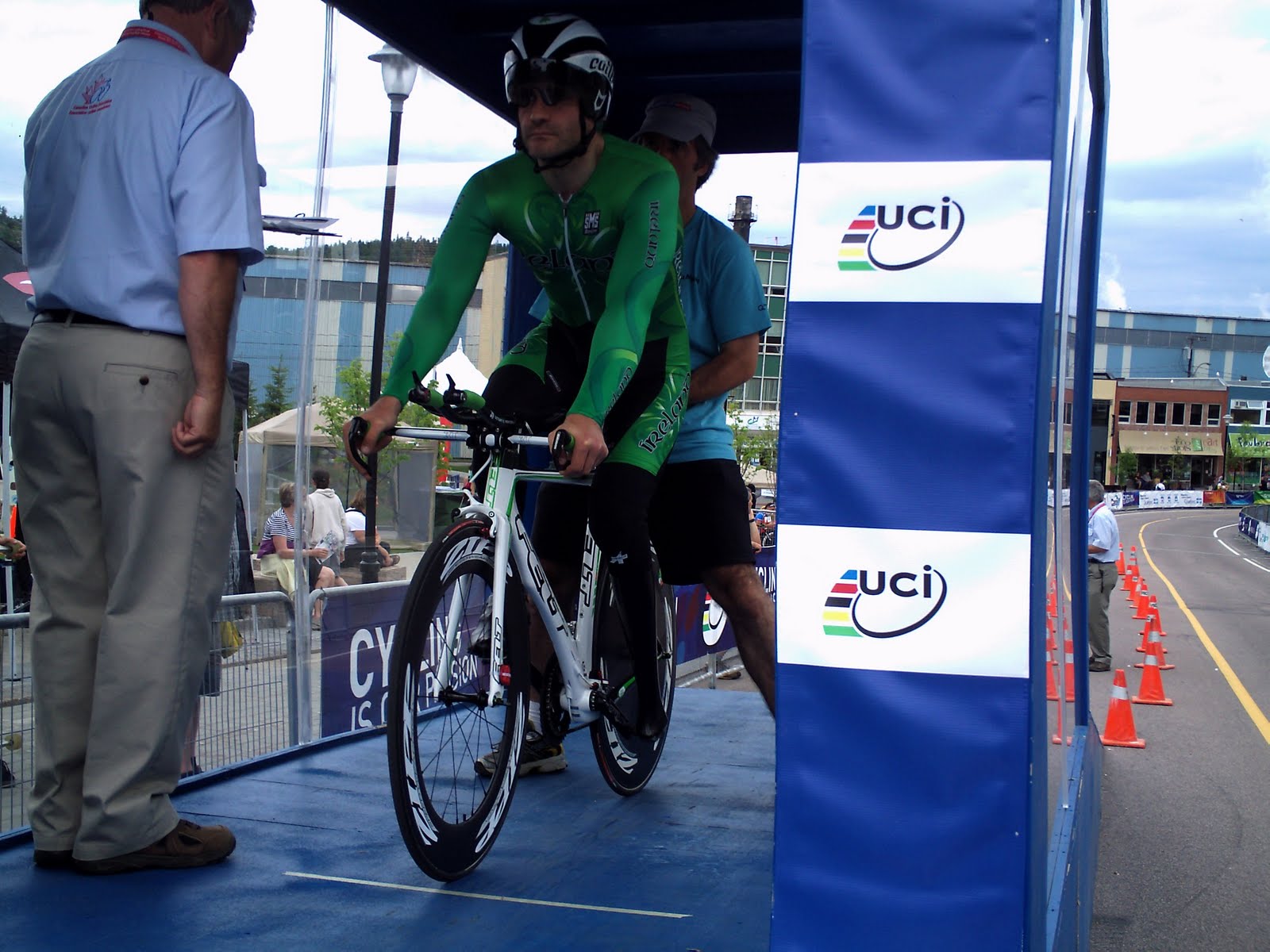
The dust has settled and the scars are now healed. It has been a long and spirited campaign, but in the end I lost out. Or did I?
In July I travelled to Canada for the final round of the Paracyling World Cup. I had a slim lead in the competition and wanted to try and secure the overall victory. But I knew it was going to be one of the toughest challenges I have faced to date.
The event was held in Baie Comeau, Quebec - site of the 2010 Road World Championships and run on the same course – a testing circuit featuring the hardest climb I have ever faced in a race; the same circuit that almost made me want to give up cycling. I have no problem admitting I was scared about facing the course again.
But I also had hope. I am almost 10kg lighter and certainly a lot fitter than I was the last time I raced up that hill (5 times). I knew it was going to be difficult, but maybe, just maybe – this time I would hang in there. At least enough to get the points I needed to win the overall title.
Myself and Mark Rohan made the long journey across the pond to represent Ireland. As we were the only two competitors leading our categories in the World Cup, the rest of the team were left behind for this event. Mark ended up winning both his races and became the first and only athlete to win all 6 races in the World Cup series. The guy is unbelievable.
First up was the time trial. Unlike the World Championships last summer, the TT wasn't held on the same course as the road race this time around. Having to time trial (twice) up a 15% climb wasn't my idea of fun so I was happy to see they had made the course a bit more accommodating. However, it was still a climber's course and less suited to a power rider who goes fast on the flat like myself. Lots of small uphill sections and one big long drag meant that it would test my TT abilities to the max.
I have been training and racing all year with the aid of a power meter. In particular it helps me pace my TT efforts, ensuring that I don't go too hard or too easy and has helped me produce some stellar results. However, when race day approached, the equipment failed. This meant that I would have to ride 'blind' and go on feel. And on a hilly course like this one, a very difficult proposition.
The race was over two laps of a 8.6km hilly circuit. I set off and quickly tried to get into my rhythm. The first portion of the course is a long uphill drag, so was difficult to get comfortable. At the top of the climb, the circuit entered a residential area with some tight, technical and high speed sections and turns. I actually enjoyed this portion of the course, navigating 90 degree bends at high speed and looking for the best line to the next turn.
After the first lap the top 5 riders were all within 10 seconds of each other. But I was starting to hurt. Riding up the sharp hills was taking its toll on my legs, and not having any feedback on how much power I was putting out was making it difficult to get my pacing right. I was going too hard up the hills and not hard enough on the downhill sections. But I powered on, hopeful that I was still doing a solid ride.
 I crossed the finish line completely empty. But I was only 5th. Sheer and utter disappointment on my part. I had expected much better from myself. The race was actually won by the talented German rider, Tobias Graf. I had beaten him by over a minute in the last round of the World Cup on a flat course in Spain. He had taken almost a minute out of ME on the hilly course in Canada. Just goes to show how much of a difference the right course can make.
I had a day off to recover before having to regroup for the road race. As mentioned previously, it was held on the same circuit as the Worlds last year. After the TT I still held a very small lead in the World Cup standings over a Spanish rider. Therefore, my goal in the road race was to try and stick as close to him as possible, marking his every move, and try and finish within 2 places of him. This would secure me the overall win that I so desperately wanted.

The race started and we were off. I had no problems staying with the main group of riders up the initial (smaller) climbs. But it was the main climb that I was worried about. As we hit the bottom of the 'big' hill I surged to the front, trying to take every advantage I could. The pack rode up the first part of the hill at a sensible pace, but as the road briefly levelled out before kicking up again, everyone powered forward and I found myself in difficulty. I knew that if I went too far into the red to try and stay with them I would pay for it later. I stuck to my own pace, slowly being distanced – but not nearly as quickly as I had been last summer on the same climb.

I crested the top of the hill and began my chase in earnest. Fortunately – I go downhill very quickly, so was able to catch back up to the main group within a few miles. But I had wasted valuable energy chasing back on. And this was to be the story of my day. Each lap I would get dropped going up the climb and each time I would chase back on. But each lap the time it took me to catch the pack grew and grew. They would get further and further up the road before I would finally catch the tail end of them and get some respite. By the final lap I only managed to catch up to them less than a mile from the base of main climb! Hardly enough time to catch my breath before being buried again going uphill.
On the 3rd lap, when I rode myself back into the bunch, I noticed that the Spaniard that I was chasing was no longer in the bunch. I rode up to one of the Brits I know and asked him if anyone had ridden off the front of the bunch. He told me 'no'. I was elated! He must have dropped out somewhere along the route while I had been chasing back on. All I had to do was finish the race and the title would be mine.
 And so... the final lap was almost over. Once again I was off the back, chasing to try and catch up, but the mammoth effort of chasing down the other riders 5 times in a row had taken it's toll. I could see the riders in the distance, but I wasn't going to catch them before the finish line. Still, thinking that I had won the overall title kept me going and raised my spirits. I crossed the finish line alone in 7th place with one arm weakly raised in a victory salute.
Compared to the 18th place I finished on the same course last summer (over 12 minutes down from the winner), 7th place (and less than 2 minutes down on the winner) was a massive step forward – especially considering that I had ridden a large portion of the race on my own.
As I went to find my coach and manager my elation soon turned to disappointment. I was informed that the Spaniard who I had been trying to keep tabs on.... hadn't dropped out of the race. In fact, he had ridden away from the entire bunch and gone on a solo breakaway. And while they managed to reel him back in, he still managed to cross the finish line 10 seconds before anyone else. And in doing so had secured enough points to rip the overall title away from me. I had travelled all that way... and lost.
I have to admit I was inconsolable at first. But I felt the worst for the people that had taken time out of their lives to come along on this trip to support me – my coach, the manager and our mechanic. I felt I had let them down. They didn't feel that way of course, but it's hard to understand these things in the heat of the moment.
It was in the days that followed that I began to put things into perspective. Yes, I had 'lost' the World Cup title. But I had still come second in the overall standings. Yes, second. Second in the entire world across a whole race series. I had won one gold and two silver medals. I had beaten my previous time by 10 minutes on the toughest course I had ever faced. And I had shown that I could race with best in the world.
Furthermore, losing the TT (on a hilly course) and finishing as far back as I did was a bit of a wake up call. Had I not experienced that, I might have gone to the World Championships later this year thinking that I had it 'in the bag'. But now I'm more realistic (the World's course is also hilly this year) and know how much more work I will have to do to win. I still know I have what it takes to win this year, I just need to train harder and prepare for the specific type of course that I'll be riding.
And that's how being a loser is a good thing. It may just turn me into a big-time winner.

 I have to admit to being sceptical of the benefits of using ceramic bearings in my bike. I've tried them before over the years with varying degrees of success. I've used both low and high grade ones in my bottom bracket and wheels, and it was easy to tell the difference between them.